
A modern SoC block can contain hundreds of thousands of flip-flops, and the clock network that feeds them is often one of the largest consumers of dynamic power in the design. Multi-bit flip-flops (MBFFs) reduce that cost by packing two, four or eight flip-flops into one library cell that shares a single clock pin and internal clock buffering. Replacing single-bit flops with MBFFs is called banking; splitting an MBFF back into smaller cells is debanking.
Banking is easy to turn on and easy to get wrong. It saves clock power and area, but it ties bits together physically and electrically, and that can hurt timing, useful skew, scan and ECOs. This guide explains how MBFFs work, the rules that decide which flops can be banked, the trade-offs with a worked example, how tools bank and debank through the flow, and how to decide when to debank.
What a multi-bit flip-flop is
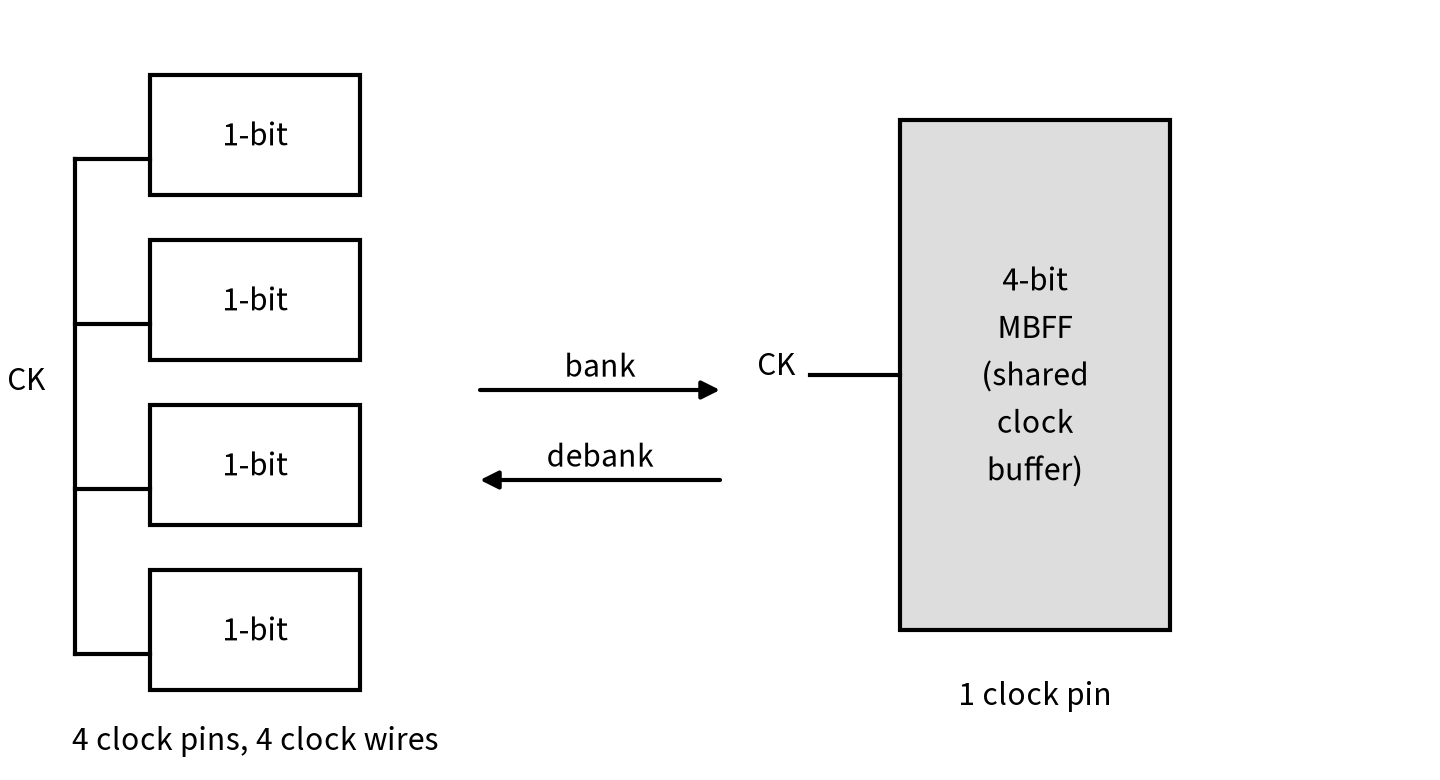
An N-bit MBFF is a single standard cell containing N storage elements that share:
- one clock pin (and usually one internal clock inverter/buffer pair instead of N),
- common control pins such as reset, set, scan enable or enable, depending on the cell,
- one cell boundary, so N separate cells become one larger one.
Each bit keeps its own D and Q (and sometimes its own scan-in/scan-out). Some libraries offer MBFFs with internal scan chaining between bits, which reduces scan routing but fixes the bit order.
Why it saves power and area
- Fewer clock sinks. CTS sees one sink instead of N, so the tree needs fewer buffers and less wire at the leaves.
- Shared internal clock buffering. Each single-bit flop has its own internal clock inverters; an MBFF shares them across bits, so less internal clock capacitance switches every cycle.
- Shared overhead area. Well taps, boundary and some internal circuitry are shared.
The exact savings depend on the library and the design. Always measure with your own library.
Worked example (illustrative)
All numbers are made up for teaching.
Say a single-bit flop presents 1.0 fF on its clock pin and its internal clock inverters switch 1.5 fF every cycle. A 4-bit MBFF presents 1.6 fF on its clock pin and switches 3.0 fF internally (shared inverters, slightly larger).
Clock-pin plus internal clock capacitance for 4 bits:
- 4 single-bit flops: 4 × (1.0 + 1.5) = 10.0 fF
- one 4-bit MBFF: 1.6 + 3.0 = 4.6 fF
Using P = C·V²·f with the clock switching every cycle (activity 1 for the clock), V = 0.75 V and f = 1 GHz:
- singles: 10.0 fF × 0.5625 V² × 1 GHz ≈ 5.6 µW per 4 bits
- MBFF: 4.6 fF × 0.5625 × 1 GHz ≈ 2.6 µW per 4 bits
That is the leaf-level saving in this made-up library, before counting the reduced clock-tree wire and buffers above the leaves. Multiply by tens of thousands of groups and the reason for banking is clear. The clock gating guide explains the same power formula in more detail.
Banking rules: which flops can be merged
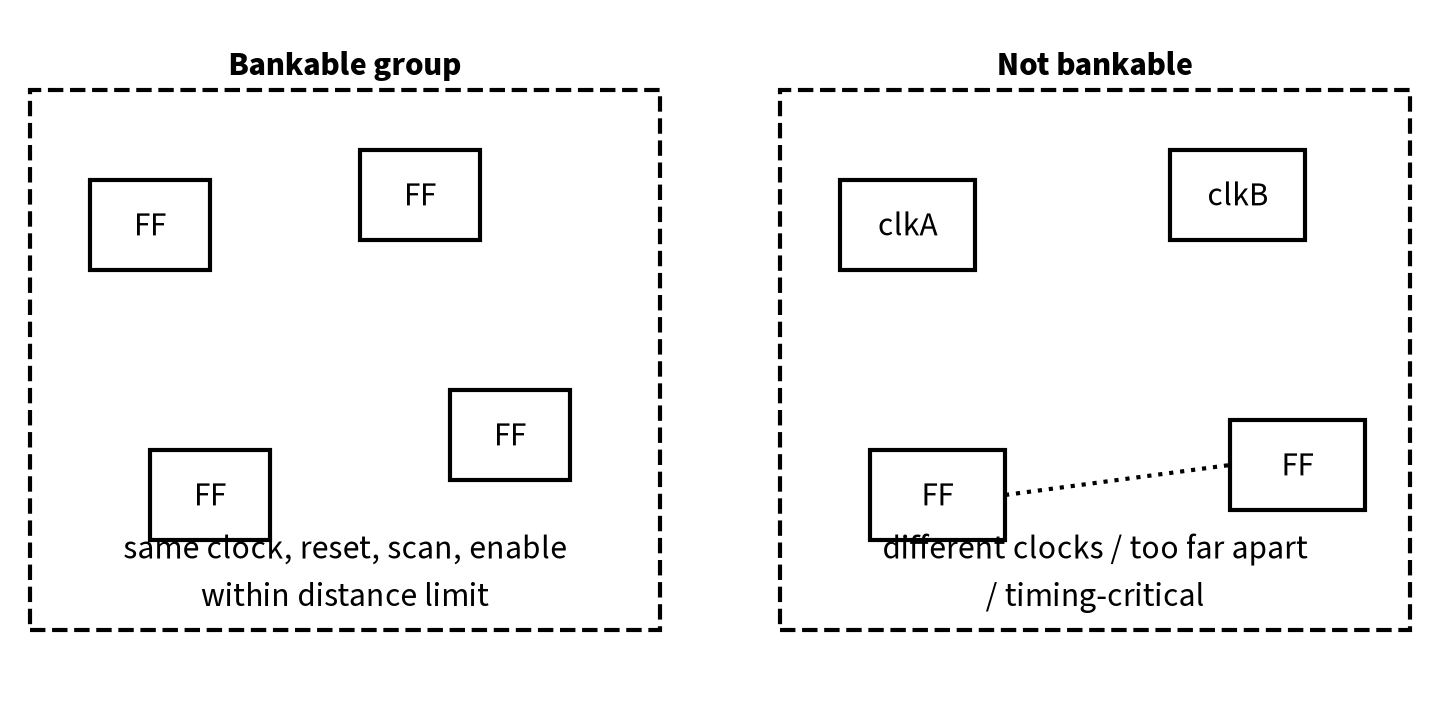
Tools only bank flops that are logically compatible and physically close. Typical conditions:
- Same clock (and same clock edge) — after accounting for clock gating. Flops behind different ICGs usually cannot be banked, because the MBFF has one clock pin.
- Same control signals — reset, set, enable and scan enable must be the same net, if the MBFF shares those pins.
- Compatible scan. If the MBFF has internal scan chaining, the bits must be consecutive in a chain (or the tool must be allowed to reorder scan).
- Physical proximity. Banking far-apart flops forces long D/Q wires to the merged location and hurts timing. Tools have a maximum distance or a timing-driven cost.
- No
dont_touchor user constraints preventing the change, and no special cells (e.g. synchronizers you want to keep as-is, or flops that need a specific cell). - Timing allows it. Critical flops are often excluded.
Banking can happen at synthesis (logical banking based on connectivity) or in P&R after placement (physical banking based on location). Physical banking usually gives better timing because it knows where the flops actually are.
The timing trade-offs
MBFFs create four timing problems that single-bit flops don’t:
1. Location is shared. All bits sit in one place. If bit 0’s logic is on the left and bit 3’s logic is on the right, at least one of them gets longer D or Q wires.
2. Clock arrival is shared. All bits get the same clock arrival time (to within internal differences). Useful skew — deliberately delaying or advancing the clock of one flop to borrow time — can no longer be applied per bit. If useful skew wants to delay bit 2 by 30 ps but not bit 0, the MBFF blocks it.
3. Larger cell, longer pin distances. An 8-bit cell is wide; pins at one end are farther from logic near the other end.
4. ECOs get harder. Changing one bit’s function or replacing one flop in an ECO may require debanking the whole cell, or the MBFF must have a spare bit.
Debanking: when and how
Debanking splits an MBFF into smaller MBFFs or single-bit flops. Most P&R tools can debank automatically during optimization when timing calls for it, and many research papers (for example, debanking studied together with useful-skew scheduling at SOCC 2023 and ICCAD 2023) explore how to choose which bits to split. Even the 2024 ICCAD CAD Contest Problem B was about power and timing optimization using MBFFs, which shows how open the problem still is.
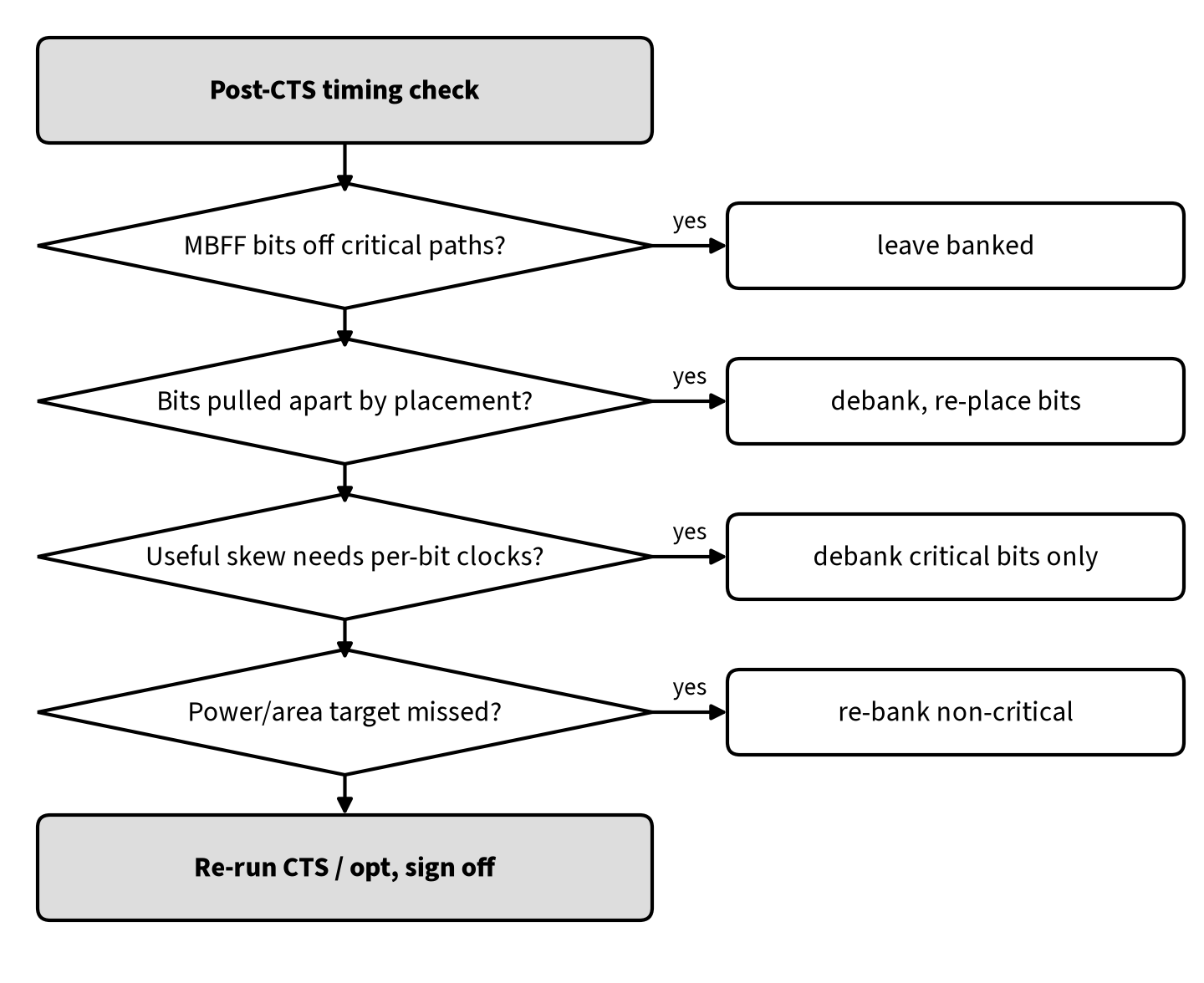
A practical method:
- After CTS and with propagated clocks, report the worst paths that start or end at MBFF bits.
- If those bits are not critical, leave the MBFF alone.
- If placement has pulled the bits’ logic in different directions, debank and let the bits be placed near their own logic.
- If useful skew wants different clock arrivals for different bits, debank only those bits (for example, split a 4-bit into a 2-bit plus two singles).
- Check power and area afterwards. If the target is missed, re-bank non-critical bits elsewhere.
- Re-run CTS or incremental clock optimization and sign off.
Worked debanking example (illustrative)
A 4-bit MBFF has bits 0–3. Post-CTS:
- bit 0: setup slack −25 ps; useful skew would delay its capture clock by 30 ps, but bits 1–3 would then lose hold margin (each has only +10 ps hold slack).
- bits 1–3: setup slack positive.
Delaying the MBFF clock as a whole would fix bit 0’s setup but violate hold on bits 1–3. Debanking bit 0 into a single flop lets CTS delay only its clock: bit 0 setup becomes about +5 ps, bits 1–3 keep their hold margin, and the cost is one extra clock sink and the area/power of one single-bit flop plus a 3-bit (or 2-bit + 1) cell. If the library has no 3-bit cell, the result might be a 2-bit MBFF plus two single-bit flops. See our setup and hold violations guide for the timing math behind this.
Reading a banking summary
Every tool reports banking differently. The summary below is representative, made up to show what to look for, not the output of any specific tool.
Multi-bit banking summary (after placement)
  Sequential cells before          : 120,400 single-bit
  Banked into 2-bit                :  8,100 cells (16,200 bits)
  Banked into 4-bit                : 14,500 cells (58,000 bits)
  Banking ratio                    :  61.6 %  (74,200 / 120,400 bits)
  Rejected - different clock/ICG   :  9,800 bits
  Rejected - control mismatch      :  6,300 bits
  Rejected - distance/timing       : 24,100 bits
  Rejected - dont_touch / user     :  6,000 bits
How to use it:
- Banking ratio is the headline number, but compare it with timing. A high ratio with many new violations is not a win.
- Clock/ICG rejections point to RTL or synthesis structure: many small gating groups split banks. Sometimes merging enables at RTL helps.
- Control mismatch often comes from different reset nets that are logically the same but were not merged.
- Distance/timing rejections are the tool protecting timing; you can loosen the distance limit, but check the effect on slack.
MBFFs and the rest of the flow
- Scan. Internal-scan MBFFs fix bit order. Allow scan reordering where possible, and check that scan stitching is done after banking.
- CTS. Fewer sinks make the tree simpler, but each MBFF is a heavier load; check transition at the MBFF clock pins. See our CTS guide.
- Congestion. Large MBFFs gather many D/Q pins in one place; in dense areas this can create local pin congestion.
- Formal / LEC. Banking changes cell names and mapping. Equivalence checking must be set up to handle banked registers (name mapping files or the tool’s MBFF support).
- Power analysis. Use realistic activity so that the reported savings reflect your design.
- Hold. Shared clocks mean you cannot fix hold on one bit by skewing; you add delay on that bit’s data path instead.
Common mistakes
- Banking across ICGs or different enables by accident (forcing the tool to restructure gating).
- Letting synthesis bank everything, then fighting timing in P&R. Physical banking usually gives better results.
- Forgetting the LEC setup until the end.
- Measuring power savings with the default activity instead of real vectors.
- Debanking everything to fix timing, and losing the power benefit you were trying to get.
Interview questions and answers
Q1. What is a multi-bit flip-flop?
A single cell containing several flip-flops that share a clock pin, internal clock buffering and sometimes control pins.
Q2. Why do MBFFs reduce power?
Fewer clock sinks and shared internal clock inverters reduce the clock capacitance that switches every cycle, and the clock tree needs fewer leaf buffers.
Q3. What conditions must be met to bank flops?
Same clock and edge, same control signals, compatible scan, physical proximity and no timing or user constraints preventing it.
Q4. Why can MBFFs hurt timing?
All bits share one location and one clock arrival, so per-bit placement and per-bit useful skew are not possible.
Q5. What is debanking?
Splitting an MBFF into smaller MBFFs or single-bit flops, usually to recover timing or allow useful skew.
Q6. Should banking be done in synthesis or in P&R?
Both are possible; physical banking after placement usually gives better timing because the tool knows where the flops are.
Q7. How do MBFFs affect equivalence checking?
Register names and mapping change, so LEC needs mapping information or explicit MBFF support.
Q8. How do you fix hold on one bit of an MBFF?
Add delay to that bit’s data path, because its clock cannot be skewed separately.
FAQ
What bit widths are common?
2-, 4- and 8-bit cells are common; availability depends on the library.
Do MBFFs affect reliability or variation?
They change local layout and clock loading, so check clock transitions and EM on MBFF clock pins like any other sink.
Are MBFFs used with clock gating?
Yes. All bits of an MBFF must share the same gated clock.
Can MBFFs be used for synchronizers?
Usually synchronizer flops are kept as dedicated cells chosen for metastability behaviour; exclude them from banking unless your library has a cell intended for that purpose.
Summary
- MBFFs share clock pin and internal clock buffering across bits, saving clock power and area.
- Banking requires same clock, controls and scan compatibility, and physical proximity.
- Shared location and shared clock arrival can hurt timing and block useful skew.
- Debank selectively — only the critical bits — and recheck power and area.
- Plan for scan, CTS, congestion and LEC impact from the start.
References
- 2024 ICCAD CAD Contest Problem B: Power and Timing Optimization Using Multibit Flip-Flop — https://doi.org/10.1145/3676536.3689911
- Debanking Techniques on Multi-bit Flip-flops for Reinforcing Useful Clock Skew Scheduling (SOCC 2023) — https://doi.org/10.1109/socc58585.2023.10256966
- Design and Technology Co-Optimization for Useful Skew Scheduling on Multi-Bit Flip-Flops (ICCAD 2023) — https://doi.org/10.1109/iccad57390.2023.10323866